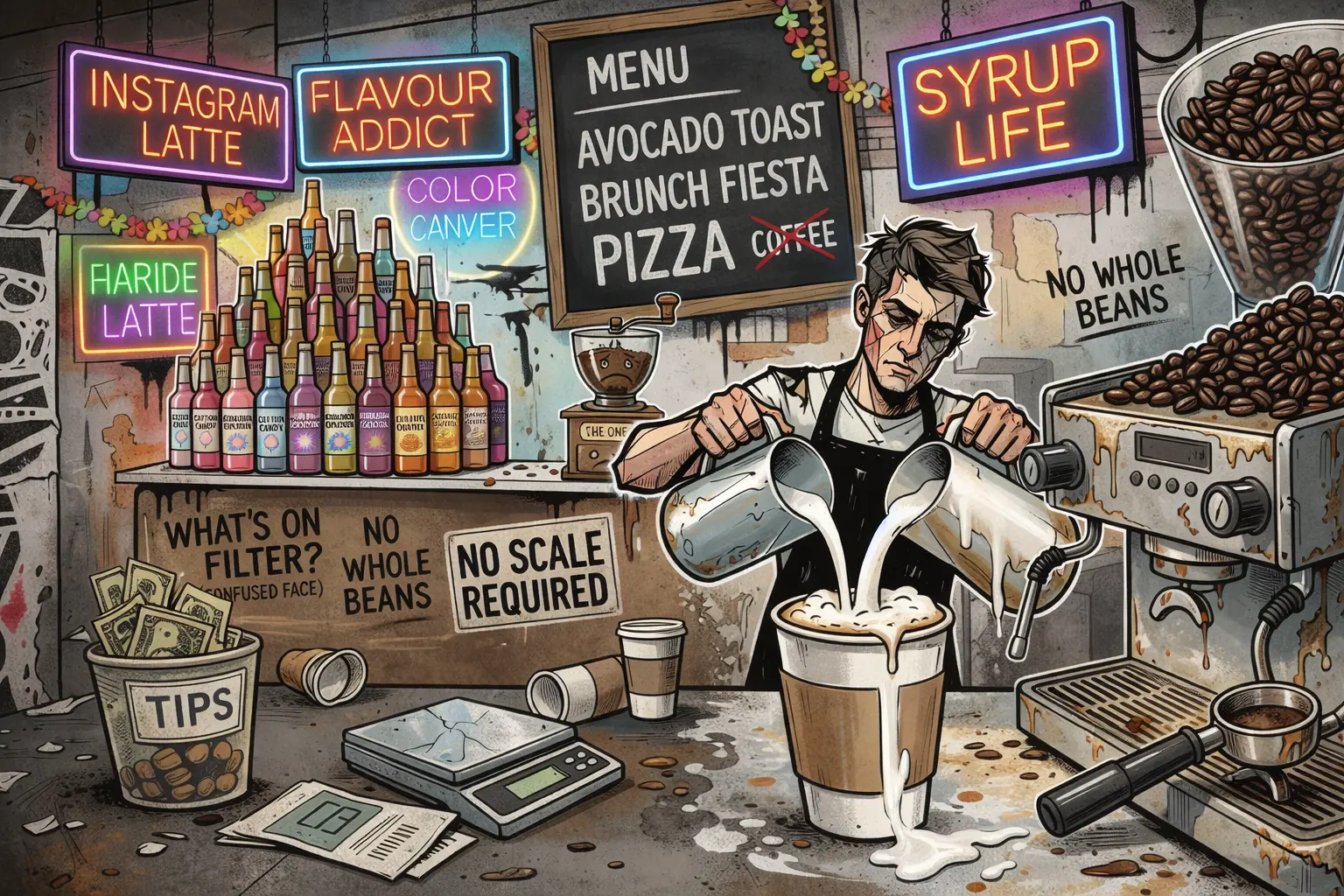
Or, how to read a coffee shop in 30 seconds.
You walk in and something feels off. It could be the wall of flavoured syrups. It could be the lone grinder doing everything.
After a while, you learn to read the signs. Some places call themselves coffee shops, but the coffee isn’t really the point.
And here’s the thing: you don’t even need to order a coffee to know whether a place is going to deliver what you’re after. If you know what to look for, the answer is usually on the counter within thirty seconds.
Here’s a simple checklist to size up a café fast. You’ll usually know by the third or fourth point.
The obvious signs
1. It looks like a selfie café.
Neon everywhere. Flowers on the walls. A menu that looks better on Instagram than it does in your hands. The focus here is the photo. The coffee just comes with it.
2. One grinder. One bean. One problem.
If there’s only one grinder, there’s only one story. One bean, pulled into every drink on the menu. Usually a safe, middle-of-the-road roast that keeps things neutral and forgettable.
Specialty cafés don’t work like that. Espresso and filter get their own grinders. It’s a small detail, but it tells you they care about how each cup is meant to taste.
3. The syrup shelf is doing a lot of talking.
Hazelnut. Caramel. Lavender. Salted caramel. Brown sugar cinnamon.
When the syrup lineup is longer than the coffee menu, you already know the deal. These drinks are built around flavouring, not the bean. If you’re chasing clarity and character, it gets lost fast.
4. The food menu is the main event.
If the blackboard is 80% brunch, and the coffee section is squeezed in at the bottom, that’s the priority. Fair enough. Don’t expect the coffee to blow your mind.
In a serious specialty coffee shop, the coffee doesn’t hide. It’s front and centre from the start.
What to look for (and warning signs) at the counter
1. No origin information anywhere.
A café that cares will tell you where the coffee comes from. Country, region, sometimes right down to the farm. Not as a flex, just as context.
If the menu stops at “espresso” or “house blend,” the story ends there. And that usually means sourcing isn’t the priority.
2. Ask what’s on filter. Watch the reaction.
You don’t have to do this often, but it’s one of the clearest signals. Ask “what’s on filter?”
A good answer comes without hesitation. Something like: “Kenyan from Nyeri. Bright, stone fruit. Great on V60.”
In a serious café, they enjoy the question. That small bit of enthusiasm tells you more than the menu ever will.
3. Everything is available as a large.
A 20oz latte stretches the espresso until there’s not much left to notice. More milk, less character.
Places that take coffee seriously keep sizes in check. Not to be difficult, but because balance matters. If you want to taste the bean, smaller is where it shows up.
4. No whole beans for sale.
A business that’s serious about coffee usually sells retail bags, partly for revenue, but also because they’re proud enough of what they’re serving to put a name on it.
No retail shelf often means they’re not working closely enough with a roaster to shout about it.
What to look at on the coffee machine
1. The steam wand.
Have a quick look before you order. It should be clean, wiped down, purged after each use.
If it’s coated in dried milk, that tells you everything you need to know. Small habits reflect bigger ones.
2. The portafilter isn’t locked in.
It should live in the group head (the part of the machine where hot water comes through), not on the drip tray. That keeps the portafilter (the handled metal piece that holds the ground coffee) hot and ready for the next shot.
If it’s sitting out, cooling down, that heat loss carries straight into the espresso. It’s a small thing, but the kind of thing good cafés don’t miss.
3. The beans look oily.
Take a look at the hopper (the clear container on top of the grinder that holds the beans). If they look slick, shiny, almost wet, they’ve been roasted dark enough that oils have been pulled to the surface.
That kind of roast (where beans are taken well past first crack, the point where they start to expand and release moisture) tends to flatten the flavour. It’s often used to cover up lower-quality sourcing rather than highlight anything specific.
If you’re chasing the bright, clean profile of a light roast single origin (coffee from one specific region or farm, not a blend), this isn’t where it shows up.
Good specialty beans, whether light or medium roast, usually look dry and matte. Not glossy. Not oily.
4. There’s no scale.
Have a look around the bar. In a place that’s dialled in, you’ll usually see a small digital scale (used to weigh the dose of ground coffee and the final yield of espresso) sitting near the grinder or under the portafilter.
Without it, they’re estimating. And espresso is sensitive to that. A gram or two either way changes how the shot runs and how it tastes.
In specialty cafés, they’re aiming for consistency, often working to a brew ratio (the relationship between coffee in and liquid out, like 18g in to 36g out). That’s how you get clarity and balance from a specific origin.
If the beans and roast are meant to be the focus, that level of precision isn’t optional. It shows up in the cup.
The Subtle Signs Most People Miss
1. The grinder is running, but nobody’s adjusting it.
Grind size (how coarse or fine the coffee is ground) doesn’t stay static. It shifts through the day as humidity, temperature, and bean age change.
A café that’s paying attention will dial it in (make small adjustments to grind size and shot time to keep the espresso tasting right) regularly. You’ll see baristas tweaking, tasting, correcting.
If it’s set and forgotten from open to close, they’re not really chasing consistency. And that shows up in the cup.
2. Nobody is tasting anything.
Good cafés taste their espresso. You’ll spot it if you’re looking, small tasting cups, a brief pause, a barista sampling a shot before the rush.
It’s part of calibration (the process of checking and adjusting the espresso so it matches the intended flavour profile). Making sure what ends up in your cup is actually tasting the way it should.
When that habit is there, you notice it. When it’s not, you notice that too.
3. The milk is doing all the work.
If every drink tastes smooth, sweet, and identical, regardless of the bean, the milk is carrying it. Usually overheated milk (steamed well past the ideal range, which flattens texture and amplifies sweetness) smoothing everything into the same result.
The espresso is technically there, but it’s not contributing much.
If you’re into light roasts, that’s where it falls down. Those brighter, more complex notes are the first thing to disappear under a heavy layer of milk.
4. The café smells like food, not coffee.
Coffee aroma should hit you as soon as you walk in.
If it’s competing with the kitchen, you can usually tell where the focus is.
5. Everything is the house blend.
One anonymous house blend (a mix of beans combined for consistency rather than distinct flavour) doing espresso, filter, and batch brew is efficient.
But a café that’s interested in coffee usually rotates single origins (coffee from one region or farm), follows seasonality, and has a point of view on sourcing.
That curiosity leads to the most interesting cups.
Final say and a (sort of) disclaimer
None of this is about being difficult or hard to please. It’s about knowing what you enjoy: clean, expressive, origin-forward coffee. And being able to spot quickly whether a place is set up to deliver it.
Most of the signs are right there on the counter. When you find a café that gets it, you’ll know. And it’s worth going back.