You've spent real money on your setup. Maybe it's a prosumer grinder that took three months to justify. Maybe it's a machine with pressure profiling and a dual boiler and a name you pronounce carefully when guests ask about it. You dialed in the dose, the ratio, the temperature. You bought a decent bag from a decent roaster. And the coffee is still... fine. Not great. Fine.
Here's what most people don't think about: espresso is 88-93% water.[4] The beans you obsessed over, the grind you calibrated, the machine you saved up for, all of it exists to influence what happens when water passes through ground coffee. And if that water is wrong, it doesn't matter how precise the rest of the setup is. Precision just makes the wrong result more consistent.
Water isn't a backdrop. It's the main ingredient. It's the solvent that either grants or denies access to the flavor you've already paid for.
Most people in coffee talk about beans. Some people talk about grind. Almost nobody talks about water. That's the gap this article is about.
Pure Water is Actually a Terrible Solvent
This surprises most people. The instinct is to assume that purer water equals better coffee: no interference, no variables, clean canvas. Makes sense. It's also wrong.
Food science literature is clear on this: deionized and distilled water is not ideal for beverages. Coffee brewed with distilled water tastes too sour.[4] Not clean. Not neutral. Sour. Because distilled water has near-zero alkalinity, which means the acids extracted from the coffee face no resistance. Everything ends up sharp at the front, empty in the middle.
The reason has to do with how flavor actually gets pulled out of coffee. It's not a passive process where water just washes compounds out of the bean. It's an ion-exchange process, driven by specific minerals in the water. Without those minerals, extraction becomes inefficient and unbalanced. The SCA's own research states plainly: at very low total hardness (below 40 ppm as CaCO3), tasters consistently report underextracted flavor characteristics.[4] Distilled water sits well below that threshold.
Softened water creates a different version of the same problem. It can skew salty or flat, and it often preserves high alkalinity even as it strips calcium, which means you get muted acidity without the compensating body.[4] "Soft" water solves a maintenance problem. It doesn't necessarily solve a flavor problem. Sometimes it creates a new one.
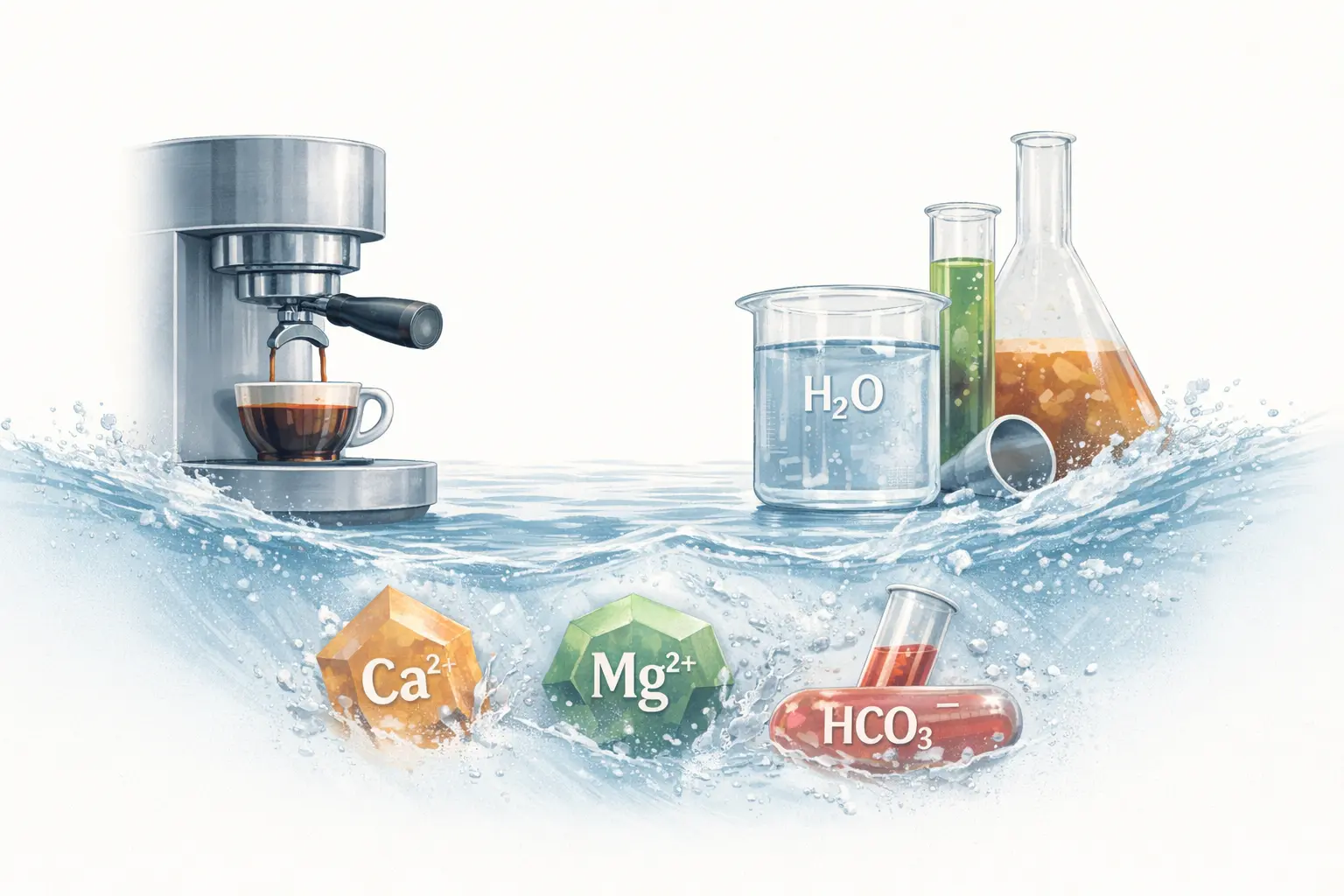
What you actually need in brew water is a specific chemical personality: the right minerals, in the right proportions, doing specific jobs.
The relationship between these three ions is what makes water chemistry both important and genuinely tricky. Magnesium pulls bright flavor. Calcium adds weight. Bicarbonate can erase both, if you let it get too high. You're tuning a three-way balance, not a single dial.
Here's where the TDS obsession causes problems. Most people talk about Total Dissolved Solids as the main metric, and it's common to see baristas with TDS meters testing their brew water. The problem: TDS doesn't tell you what the dissolved solids actually are. One hundred mg/L of bicarbonate behaves very differently from 100 mg/L of magnesium salts. The meter gives you one number for both.[4] The chemical personalities are completely different.
What matters isn't how much is dissolved. It's what.
The Chemistry, Without the Chemistry Degree
The bicarbonate reaction is worth understanding, because it's what's actually happening when bright coffee becomes flat coffee in hard-water cities.
Coffee is naturally acidic, typically between pH 4.5 and 5.2. Those acids, citric, malic, acetic, and others, are the source of the brightness you taste in a well-sourced light roast. When water with high bicarbonate content hits that coffee, a neutralization reaction happens immediately.
What that means in practice: the bright citrus note in a Kenyan AA, the stone fruit in an Ethiopian natural, the floral lift in a Guatemalan washed, all of those flavor impressions live in the acidic compounds that bicarbonate is chemically designed to neutralize.
The SCA puts a useful number on this. Research from their water standards work found that each 100 ppm (as CaCO3) of alkalinity can raise coffee pH by roughly 0.22 units.[4] That sounds small. On a logarithmic scale, it isn't. And London tap water regularly runs alkalinity above 200 ppm. Do the math.
Dr. Christopher Hendon of the University of Oregon is direct about it: "Alkalinity is the silent killer of specialty coffee. Excessive HCO3- levels above 70 ppm flatten the vibrant acidity of light-roast coffees, resulting in a dull, chalky, and earthy sensory profile."[2]
"Alkalinity is the silent killer of specialty coffee. Excessive levels flatten the vibrant acidity of light-roast coffees, resulting in a dull, chalky, and earthy sensory profile."
Dr. Christopher Hendon, University of Oregon, Journal of Coffee Chemistry (2025) [2]The buffer paradox, as the research calls it: bicarbonate acts like a volume knob for acidity. More HCO3- doesn't just reduce acidity a little. Because it's a chemical capacity, not a single reaction, it can dominate pH effects by orders of magnitude. One liter of tap water with 150 ppm alkalinity can neutralize 100 liters of pH 4.5 acidic rain.[4] Coffee is in that fight every time you brew.
What the SCA Says the Numbers Should Be
The Specialty Coffee Association updated its Water Standards in late 2025. These aren't just recommendations. They represent a research-based consensus on the mineral ranges that produce both good flavor and reasonable equipment safety.[1]
| Parameter | SCA Target (2026) | Acceptable Range | What happens outside the range |
|---|---|---|---|
| TDS | 150 ppm | 75-250 ppm | Too low: hollow, underextracted. Too high: chalky, mineral interference. |
| Calcium Hardness | 68 ppm (as CaCO3) | 50-175 ppm | Too low: flat, lacks body. Too high: scale risk, over-extraction tendency. |
| Total Alkalinity | 40 ppm (as CaCO3) | 40-70 ppm | Too low: sharp, sour, unbalanced. Too high: muted, chalky, earthy. |
| pH | 7.0 | 6.5-7.5 | Too acidic: metallic notes. Too alkaline: soapy quality. |
| Sodium | 10 mg/L | <30 mg/L | Above 30 mg/L: salty aftertaste that competes with sweetness. |
| Chlorine / Chloramine | 0 | Not detectable | Reacts with phenolic compounds in coffee to produce medicinal off-flavors. |
One important note on the espresso adjustment: brewing ratios matter. Filter coffee uses roughly a 1:15 water-to-coffee ratio. Espresso uses around 1:2. That means espresso has far less water available to buffer the same amount of coffee acids, so the alkalinity range for espresso can technically go higher before it causes the same sensory dent. The SCA's 2025/2026 update acknowledges an Espresso Safe Zone that allows alkalinity up to 150 ppm for espresso applications, but only if calcium hardness is kept very low to prevent boiler damage.[1]
You're managing two constraints simultaneously: what makes the coffee taste right, and what keeps the machine from destroying itself.
Where Your City's Tap Water Probably Stands
Here's the part that affects you directly. Most municipal tap water, in most major cities, doesn't come close to SCA compliance. Not because water treatment is bad. Because tap water is designed for safety and infrastructure, not specialty coffee extraction.
Chalk and limestone geology drives extreme hardness. Alkalinity is 3 to 5 times the SCA target. London tap water is effectively a flavor killer for light roasts.
Naturally very soft. Good for equipment, but produces hollow, underextracted cups without remineralization. Melbourne's top cafes add minerals back in.
Lauded for water quality, but the LSI averages around -2.13, meaning it is corrosive. It can leach metals from older plumbing and damage boiler components.
The global benchmark for brew-ready tap water. Naturally soft profile, well-aligned with SCA targets. Needs only basic carbon filtration to remove chlorine.
Some of the hardest water in Europe. Produces heavy body, but destroys acid clarity. It also helps explain why dark, bitter espresso became the dominant style in southern Italy.
The Naples data point is worth sitting with for a second. Southern Italian espresso culture built itself around extremely dark roasts, intense bitterness, and low acidity. That's not just an aesthetic preference. It's a practical adaptation to water that would annihilate any delicate origin character in a lighter roast. The coffee culture literally evolved to work with the water it had.
London has the same problem, less extreme. Research from Thames Water shows that Bromley, an average London borough, not an outlier, has mean total hardness of 289 mg/L and alkalinity of 215 mg/L.[4] That's roughly 1.7 times above the SCA's upper hardness limit and up to 5 times above the alkalinity target. A roaster in London developing a naturally processed Ethiopian for sale in Tokyo would need to be thinking about two completely different water environments when writing their tasting notes.
This is the geography lottery the deep research report talks about: same coffee, same machine, different city, completely different cup.[4] The solvent changes. The result changes with it.
The Machine vs. Taste Conflict
Here's where it gets genuinely complicated. Because the ideal water for flavor extraction and the ideal water for equipment longevity are not the same thing.
Most commercial cafes treat their water to protect their boilers from limescale. That's rational. A La Marzocco GB5 or a Slayer costs the same as a decent used car, and scale is what kills it. But the filtration systems designed to protect equipment tend to strip the minerals that make extraction work, or they raise alkalinity in ways that mute the coffee.
La Marzocco's own published water specification calls for TDS 90-150 ppm, total hardness 70-100 ppm, and alkalinity 40-80 ppm.[4] That's a flavor-friendly range. It's also a machine-protection range. They're trying to solve both problems at once, and the specification exists because using the wrong water voids the warranty.
The tension the research identifies: if you prioritize flavor for light roasts, you may push hardness and alkalinity into ranges that accelerate scale or corrosion. If you prioritize scale prevention, you may end up with RO water that's close to pure H2O, corrosive, flat-tasting, and organoleptically poor unless you add minerals back.[1]
This is the real reason water treatment is an industry, not just a hobby. There's no single correct answer that solves flavor, equipment safety, and economics simultaneously for every water profile in every city.
What Scale Actually Costs You
The Langelier Saturation Index (LSI) is the tool water technicians use to predict whether water will form scale, corrode metal, or behave neutrally. The calculation involves pH, temperature, calcium hardness, alkalinity, and TDS.
A positive LSI above +0.30 means scale-forming water: calcium carbonate precipitates on heating elements, clogs water passages, reduces heating efficiency. A negative LSI below -0.30 means corrosive water: it leaches metals from copper boilers and brass fittings, introducing contaminants into your cup and degrading the machine from the inside.[1]
In 2026, the industry target for espresso machines is a slightly positive LSI between 0.2 and 0.7, enough to form a microscopic protective layer on the metal, without impeding water flow.[1]
The five-year economic data on this is stark.
The $0 upfront option ends up costing three to four times more over five years, before you even factor in what the coffee tastes like during those years of scale buildup.
Deloitte's 2025 foodservice equipment report confirms the direction: proactive water management cuts long-term maintenance costs by 35% through predictive servicing and prevention of 80% of common clogs.[1] The ROI math on a proper filtration system is not complicated once you run the numbers.
The RO Problem Nobody Talks About
Reverse osmosis is the standard first step toward water customization. Strip everything out, get close to pure H2O, then add back what you actually want. It works. But it has a cost that rarely gets discussed.
The US EPA's 2024 WaterSense statement on point-of-use RO systems is candid: a typical system sends five gallons or more down the drain for every gallon of treated water it produces. At 20% efficiency, that's 4 liters wasted per 1 liter produced. At 10% efficiency, which some systems hit, it's 9 liters.[4]
At a mid-case 30% efficiency, you're dumping 2.3 liters for every liter of usable water. The EPA is explicit enough about this that it instructs manufacturers to communicate the waste ratio to buyers.[4]
So the process is: waste several liters of tap water to produce empty water, then pay again to add minerals back in. The environmental cost is real, and it matters more as specialty coffee intersects more seriously with sustainability claims.
Some newer systems have improved significantly on this, advertising close to 1:1 waste-to-product ratios. The EPA treats that as a notable improvement rather than a baseline, which tells you something about where the industry is starting from.[4]
The Market That Built Up Around This Problem
Water chemistry awareness has turned into a sizeable industry. The global Water-as-a-Service market for cafes reached $70 billion in 2025, growing at a CAGR of 29.6%.[3] That's not a niche. That's an industry responding to a real and widespread problem.
Companies like BWT and Pentair now offer subscription filtration with real-time mineral monitoring and automatic filter replacement. Their connected systems alert technicians when a filter change is needed, removing the technical burden from cafe owners who would rather focus on the coffee than the chemistry behind the coffee.[1]
January 2025 also saw Third Wave Water acquire Perfect Coffee Water, consolidating the precision mineral supplement market. It's an interesting signal: two companies that sell lab-formulated mineral packets for remineralizing distilled or RO water are now one company. Their mineral profiles were different, and the merger reflects the market sorting out which approach wins at scale.[1]
Is This Just Another Way to Gatekeep Coffee?
It's a fair question. The water conversation can easily turn into a jargon arms race: buffer capacity, carbonate hardness, LSI, precision mineral profiling. If the goal is to make specialty coffee feel more accessible, that's not a great look.
But the sources that underpin water science also undermine the gatekeeping frame. The SCA's own framework explicitly separates what's objective from what's subjective. Measure and Treat are rational processes with clear right and wrong answers for a given context. Aim, meaning what you actually want the coffee to taste like, is subjective. The SCA explicitly says there isn't enough data to define one perfect mineral composition for all coffees and all brewing methods.[4]
That's almost the opposite of dogma.
The most cited findings against soft or distilled water aren't boutique tasting notes from competition judges. They're blunt sensory defects: too sour, too flat, salty. Those are things any coffee drinker can notice on their first cup.[4]
The defensible version of this argument is simple: water science isn't about making coffee harder to access. It's about making the largest ingredient in the cup less random. If your water is working against the bean you paid for, that's worth knowing. You don't need to buy a $500 filter. Knowing your city's tap water profile and choosing a target mineral range puts you miles ahead of where most home setups operate.
Or, put plainly: you can ignore water chemistry. It won't ignore your machine.
What to Actually Do With This
Start with your city's tap water report. Most municipalities publish annual water quality reports online. Look for total hardness and alkalinity specifically, not just TDS. If hardness is above 150 ppm as CaCO3 or alkalinity is above 70 ppm, your tap water is working against light and medium roasts.
A basic carbon filter removes chlorine and chloramine, which is a simple first step for any city. If your water is in the near-compliant zone, that might be enough.
For harder water, a softening system or basic RO with remineralization gets you into a controllable range. At home, Third Wave Water and similar mineral packets are a practical way to build a consistent SCA-adjacent profile without the complexity of a full filtration setup. At a cafe level, the TCO data above makes the case for a proper system fairly clearly.
For the brewing nerd who wants to go further: a high-magnesium profile favors light-roast clarity and origin expression. A higher-calcium profile shifts body and weight. Adjusting alkalinity changes where the acidity lands on the palate. Next time you're at your local roaster, ask which water profile they brew their tasting room on. Most serious roasters have thought about this, and it's a good conversation.
The most expensive cup of coffee you're making right now might not be the Gesha you bought last month. It might be the everyday bag you've been brewing with tap water that quietly mutes everything you paid for.
Water doesn't taste like anything obvious. That's exactly what makes it so easy to ignore, and so consequential when you do.