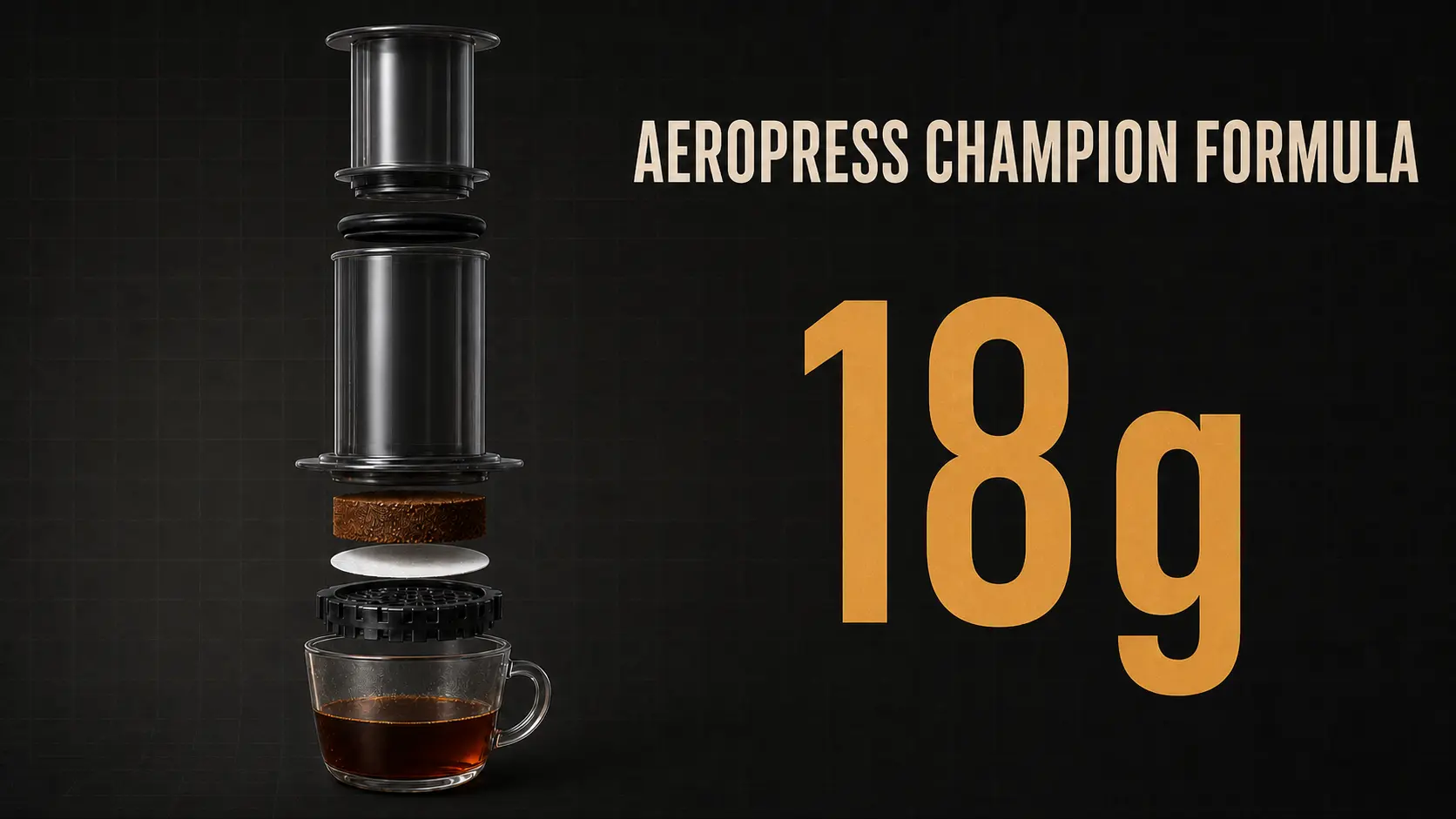
Every winner of the World AeroPress Championship since 2021 has used exactly 18 grams of coffee. Not 17.9. Not 18.5. Eighteen, five champions in a row.[1]
That is either a remarkable consensus or a sign that the competition has stopped experimenting. Both are true, and the recipes prove it.
The organizers publish every winning recipe, down to the stir pattern and the second the brewer gets flipped. The archive runs back to 2008 and I pulled all of it and laid it side by side. But the story doesn't look much like the one the coffee world tells about the AeroPress.
The winning recipe blew up, doubled in size, then snapped back to where it started.
- Every champion since 2021 brewed exactly 18 grams. Five in a row. Not 17.9, not 18.5.
- The dose wasn't always 18 grams. It spiked to 35 grams between 2016 and 2019, then fell back.
- Nine straight champions, from 2015 to 2024, brewed inverted. The 2025 winner broke the streak, brewing upright.
- Temperature, grind, and water chemistry never converged. Winners brewed anywhere from 75°C to 96°C.
- Modern winners brew a small, strong concentrate, then dilute it. In the 2022 win, 60% of the cup was bypass water that never touched the grounds.
- At home, weigh your dose and split your water. Temperature and grind are still open questions.
The Dataset
This data set pulls from eighteen world championships, minus two. There was no winner in 2020, when the pandemic cancelled the final, and the 2008 champion's recipe was never published.[1] That leaves 16 winning recipes with full parameters, from Lukasz Jura in 2009 to Némo Pop in 2025.
Each recipe looks like a small pile of variables. Dose, grind, water temperature, water chemistry, filter type, brewer orientation, stir count, press speed, and whether the brewer adds water after the press. Most home brewers worry about two or three of these. A competitor has to commit to all of them, in public, under a timer.
The dataset is not large. Statistically speaking, sixteen points are not enough for a sample. This is a population, meaning the full set of people who have outperformed everyone else. You can't run regressions on it, and I won't pretend otherwise. But you can watch how the numbers shift from year to year. AeroPrecipe keeps a parallel archive of the same championship recipes, and I used it to cross-check the official page.[5]
| Year | Champion | Dose | Method | Temp | Bypass |
|---|---|---|---|---|---|
| 2009 | Lukasz Jura (Poland) | 20g | Inverted | 75°C | No |
| 2010 | Marie Hagemeister (Denmark) | 20g | Inverted | 80°C | No |
| 2011 | Jeff Verellen (Belgium) | 17g | Upright | 80°C | No |
| 2012 | Charlene de Buysere (Belgium) | 18.3g | Upright | 85°C | No |
| 2013 | Jeff Verellen (Belgium) | 17g | n/a | 83°C | No |
| 2014 | Shuichi Sasaki (Japan) | 16.5g | Upright | 78°C | No |
| 2015 | Lukas Zahradnik (Slovakia) | 20g | Inverted | 79°C | No |
| 2016 | Filip Kucharczyk (Poland) | 35g | Inverted | 81°C | Yes |
| 2017 | Paulina Miczka (England) | 35g | Inverted | 84°C | Yes |
| 2018 | Carolina Garay (USA) | 34.9g | Inverted | 85°C | Yes |
| 2019 | Wendelien van Bunnik (Netherlands) | 30g | Inverted | 92°C | Yes |
| 2021 | Tuomas Merikanto (Finland) | 18g | Inverted | 80°C | No |
| 2022 | Jibbi Little (Australia) | 18g | Inverted | 90°C | Yes |
| 2023 | Tay Wipvasutt (Thailand) | 18g | Inverted | 89°C | Yes |
| 2024 | George Stanica (Romania) | 18g | Inverted | 96°C | Yes |
| 2025 | Némo Pop (Australia) | 18g | Upright | 84°C | Yes |
The Chaos Years
The first six winners, from 2009 to 2014, have almost nothing in common. Lukasz Jura won in 2009 with a 20-gram dose and a total contact time of about 15 seconds, roughly the time it takes to order a coffee.[1] Marie Hagemeister won a year later with the same dose and a slow 80-degree steep. Jeff Verellen won twice, in 2011 and 2013, with 17 grams both times.
Look at the doses across those years and you see a field that hadn't yet decided what the AeroPress was for. 16.5 grams, 17, 18.3, 20. Method bounced between upright and inverted. Temperature ranged from 75 to 85 degrees with no obvious center.
The AeroPress is a plastic tube with almost no rules, and in those early years nobody had written the playbook. Every champion wrote their own. The 2014 winner, Shuichi Sasaki, brewed at 78 degrees and pressed for 75 seconds. The 2009 winner was done in 15. Both used the same device, but they clearly disagreed about what it was for.
The 2013 winner, Jeff Verellen again, published a recipe so terse it doesn't even state the brewer orientation. Four lines. Bloom, add water, press, leave some behind. Compare that to the 2025 champion's recipe, which lists the water in parts per million, the exact click setting on a named grinder, and the micron size of the sifted grounds. The sport got more precise because the field got better, not because the coffee changed.
The 35-Gram Era
Then, in 2016, the dose more than doubled. Filip Kucharczyk won with 35 grams of coffee and 81-degree water, then added another 100 to 120 grams of water after pressing.[1] A year later Paulina Miczka won with 35 grams, 370 grams of water, and a brew so concentrated it hit 4.5% TDS before she diluted it back down.[2]
Miczka's was the big-dose bypass method, and for four straight years it owned the podium. 2016, 2017, 2018, 2019: 35, 35, 34.9, 30 grams. The idea was simple and a little counterintuitive. Brew a huge dose into a small, intense concentrate, then add plain water to reach drinking strength. The bypass water never touches the grounds, so you control extraction and strength as two separate dials.
Miczka told AeroPrecipe the 35-gram recipe wasn't a competition stunt.[2] The 2017 final drew close to sixty competitors from around the globe, a record at the time, and Miczka's was the recipe they all had to beat.[3] Barista Magazine published the full podium recipes that year.[4]
At 35 grams, a single AeroPress uses roughly twice the coffee of the standard 18-gram cup. The logic still held. More coffee, brewed fast, gave a cleaner and more controllable cup than trying to squeeze a normal dose into a perfect extraction. The 2019 champion, Wendelien van Bunnik, used 30 grams and 92-degree water, then pressed the whole thing in a single minute.[1]
Then it stopped. The 2021 champion used 18 grams. So did the next four. Averaged out, the three eras read 18.4 grams, then 33.7, then exactly 18.0.
Inverted Takes Over
The other thing that converged was the orientation of the brewer. Between 2015 and 2024, nine consecutive champions brewed inverted.[1] Inverted means the AeroPress sits upside down with the plunger as the base, so the coffee steeps without dripping through the filter until you flip and press.
Early on, the field split. 2009, 2010, and 2015 went inverted. 2011, 2012, and 2014 went upright. Then inverted won and never stopped.
The reasoning is usually framed as control. In the upright position, coffee starts dripping through the filter as soon as water goes in. That early drip is under-extracted, and the amount you lose depends on your grind and how fast you pour. Inverted kills the drip entirely. You decide when extraction starts, because nothing leaves the chamber until you flip it. Barista Hustle has a whole technical breakdown of how plunging pressure and speed shape the cup.[6]
The inverted method has one real cost. You have to flip a hot, full, pressurized tube of coffee and water over your cup, quickly, without spraying anything. It's the one moment in the whole routine where a champion can look clumsy. That the top competitors accepted that risk for nine straight years tells you how much they value the control.
Nine years is a long time for any method to go unchallenged. Then in 2025, Némo Pop won upright, with a flow-control cap that slows the drip instead of eliminating it.[1] It's too early to call that a new era. But it's the first time in nine years that inverted didn't win.
The Parts That Never Converged
If dose and orientation settled into place, temperature didn't. The winning recipes span 75 to 96 degrees Celsius, a 21-degree spread.[1] The 2009 champion brewed at 75. The 2024 champion, George Stanica, brewed at 96, near boiling, and still won.
There's no trend line here, just scatter. 80 degrees won in 2021. 90 won in 2022. 89 in 2023. 96 in 2024. 84 in 2025. If you were hoping the data would hand you a single correct water temperature, it won't, because the champions themselves never found one.
Grind is the same story, only harder to measure. The recipes describe it in clicks on a specific grinder, in microns, or in words like "coarse" and "slightly finer than filter."[1] You can't line those up on one axis without guesswork. What's clear is that winners have used everything from very fine to very coarse, often changing grind to chase the coffee rather than the other way around.
The same scatter shows up in water chemistry. The 2019 champion brewed with Spa Blauw, a bottled water at about 30 parts per million of dissolved minerals.[1] The 2025 champion built 125 ppm water from scratch and bypassed it at 50 degrees. In between, winners cycled through Third Wave Water, Aquacode, and Perfect Coffee Water at different strengths. From 2021 to 2025, no two champions used the same water recipe, and the field can't agree on what the water should even taste like.
None of this helps anyone selling a perfect recipe. Home brewers argue most about temperature and grind, and those happen to be the two variables the champions still can't agree on. The variables the champions did settle, dose and orientation, barely come up in most home kitchens.
What an 18-Gram Recipe Actually Is
The 18-gram recipe is really a family of recipes rather than a single formula. Here's what it looks like when a modern champion builds a cup.
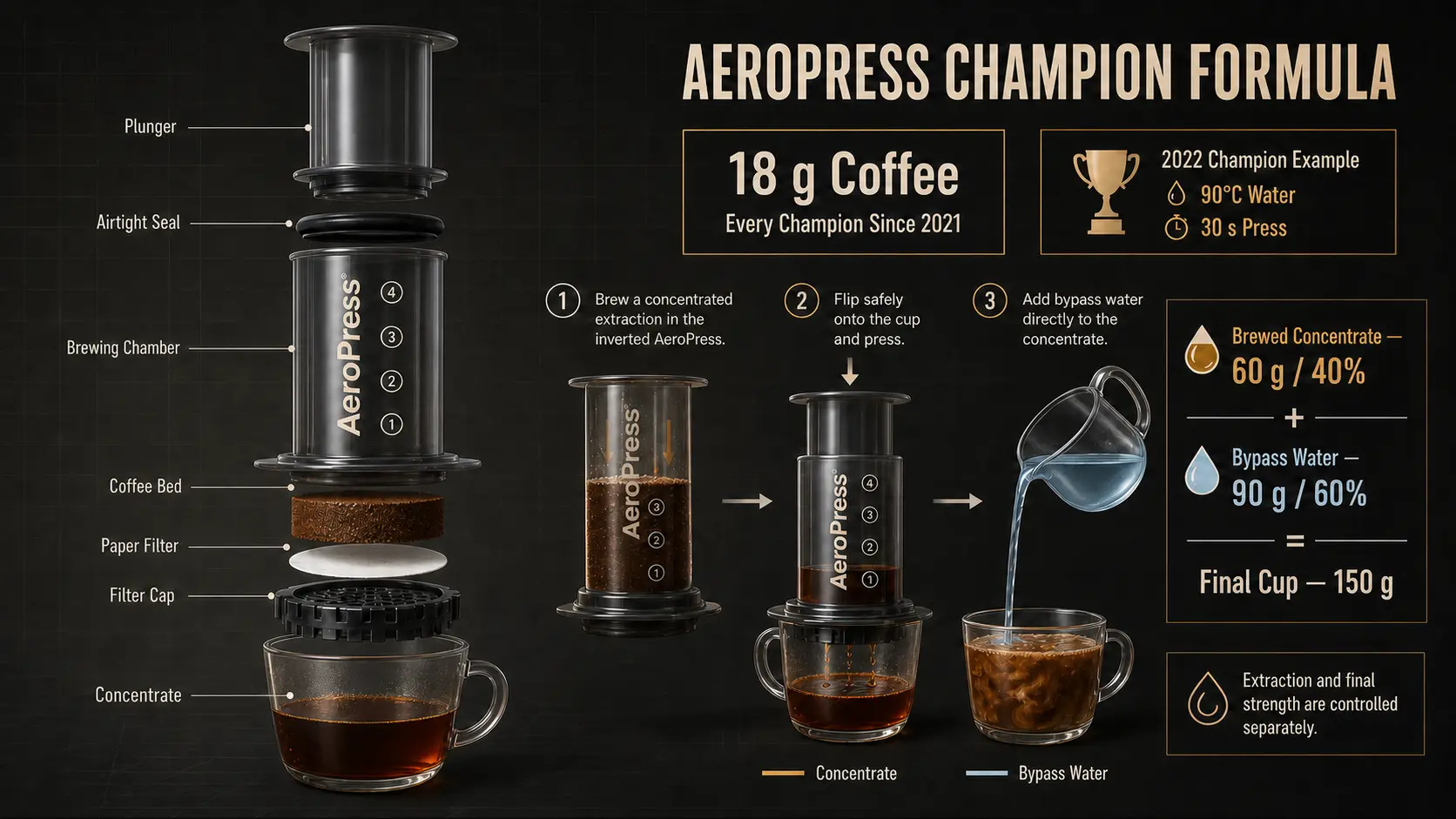
Jibbi Little won in 2022 with 18 grams, 90-degree water, and an inverted brew pressed for 30 seconds. That produced about 60 grams of concentrated coffee. Then she added 90 grams of plain water. Sixty percent of the liquid in her winning cup never touched the coffee grounds at all.[1]
That's the hidden shape of the modern winning recipe. You brew a small, intense concentrate, then dilute it to strength. The big-dose era of 2016 to 2019 made this famous, and the 18-gram era kept the technique while shrinking the dose.
The side-by-side below shows how far the recipe travelled. Wendelien van Bunnik's 2019 win used 30 grams and a one-minute press. George Stanica's 2024 win used 18 grams and a slower, more deliberate bloom. They agree on the basic method, but not on much else.
Wendelien van Bunnik
George Stanica
What the Outliers Teach You
Every dataset has its weird ones, and they're the most instructive. The 2009 champion, Lukasz Jura, brewed for about 15 seconds.[1] Most modern recipes steep for a minute or more. His win suggests the AeroPress is far more forgiving than the recipe forums imply, or that the early judging rewarded something different.
The 2021 champion, Tuomas Merikanto, brewed at 80 degrees with 200 grams of water, a low-and-slow method that looks nothing like the hot, fast brews on either side of it. The 2023 champion, Tay Wipvasutt, split his 18-gram dose into two parts, adding 2 grams of coffee mid-brew.[1] That's not a detail you'll find in any beginner's guide. The 2024 champion brewed near boiling, which most home brewers are told will ruin the cup.
The outliers matter because they mark the edges of what actually works. A 15-second brew won. A 96-degree brew won. A split-dose brew won. If all of those can win a world championship, then the space of correct AeroPress brewing is much larger than the recipe blogs imply. The consensus recipe is real. But it's the middle of a range, and the edges are just as valid.
Should You Copy a Champion?
Here's what actually transfers to your kitchen. The champions agree on two things that most home brewers get wrong. Weigh your dose, and split your water.
Eighteen grams became common because it strikes a practical balance between strength, brewing time and coffee use. What matters most is that every recent champion weighed their coffee. If you're scooping by eye, you're giving up the one variable the best in the world refuse to leave to chance.[1]
Splitting your brew into a concentrated press plus plain water gives you a strength dial that's separate from extraction. That's the bypass method, and it survived the death of the 35-gram era. The champions shrank the dose and kept the dilution.
As for temperature and grind, the data gives you permission to stop asking. The winning range is wide enough that the specific number matters less than the coffee and the palate. Stanica said it plainly when he published his recipe.[1]
Weigh 18 grams, brew inverted if you like the control, and dilute to strength. Temperature and grind are still up for argument, and sixteen champions haven't settled them.